As Amazon Associates, we earn from qualifying purchases. This means we may receive a small commission at no extra cost to you if you click through and make a purchase.
Finding the right flir camera for iphone comes down to matching your phone’s physical connector, choosing your preferred attachment style, and determining how much thermal detail your project demands. Thermal imagers work by reading infrared energy rather than visible light, translating surface temperatures into a color-coded heatmap. When shopping for mobile attachments, beginners are often caught between plug-in dongles that lock into the charging port and wireless units that communicate over an independent radio signal. Selecting the wrong model often means ending up with a device that physically cannot connect to your phone or one that produces images too coarse for precise diagnostics.
The FLIR mobile lineup is divided systematically into plug-in dongles and wireless modules. For direct physical attachments, the brand produces dedicated versions differentiated by port type: Lightning connectors for older Apple smartphones and USB-C connectors for newer generation hardware. Alongside port differences, the manufacturer organizes its hardware into standard and professional tiers. Standard models offer an entry-level native thermal sensor of 80×60 pixels, while Pro tiers step up to a 160×120 native infrared sensor. The Edge series branches off into wireless Bluetooth modules that eliminate port compatibility problems entirely while letting you reach into awkward crevices.
FLIR Thermal Cameras Lineup at a Glance
| Model | Connection Type | Native Sensor | Upscaled Resolution | Key Benefit |
|---|---|---|---|---|
| Flir One Pro | Direct USB-C | 160×120 IR | 480×360 | High detail for modern USB-C phones |
| Flir One | Direct USB-C | 80×60 IR | 240×180 | Entry thermal resolution for newer phones |
| FLIR ONE Pro LT | Direct Lightning | 80×60 IR | Not Specified | Native plug for Lightning-based iOS devices |
| Flir Edge | Wireless Bluetooth | 80×60 IR | 240×180 | Cordless design with 2-meter drop rating |
| Flir Edge Pro Wireless Thermal Imaging | Wireless Bluetooth / Wi-Fi | 160×120 IR | 480×360 | Cordless design with high thermal resolution |
| Flir One Pro Thermal Imaging Camera | Direct USB-C | 160×120 IR | 480×360 | High thermal resolution tailored for Android |
Figures as published on the product listings.
The Models in Detail
Flir One Pro
- Best for Android USB-C smartphone owners
- Color Ios
- Weight 0.08 pounds
- Size 17 x 10 x 7 cm
- Dimensions 2.7 x 0.6 x 1.4 Inches
Pros
- Sharp 160×120 thermal sensor
- Direct USB-C plug attachment
- Real-time MSX edge details
- Guided inspections in mobile app
Cons
- Configured for Android devices

Our score: 9.2/10
Best for: Older iPhone users with Lightning connectors
Pros
- Native Apple Lightning connector
- Direct FLIR Ignite cloud sync
- Adjustable OneFit connection dial
- Rugged 1.5-meter drop rating
Cons
- Incompatible with USB-C iPhones
- Not waterproof
Our score: 8.8/10
Best for: Homeowners doing quick DIY heat checks
Pros
- Direct USB-C iPhone connection
- VividIR upscaling to 240×180
- Integrated MSX edge enhancement
- Includes in-app inspection guides
Cons
- Lower native 80×60 thermal sensor

Our score: 9.8/10
Best for: Modern iPhone owners inspecting building insulation
Pros
- 160×120 native sensor resolution
- Direct USB-C iPhone connection
- VividIR upscaling to 480×360
- Drop tested to 1.5 meters
Cons
- Requires phone with USB-C port
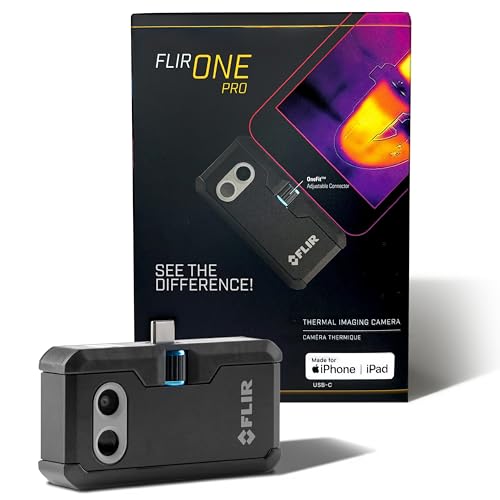
The Flir One Pro is a direct-attach mobile thermal imager designed specifically for smartphones featuring a USB-C charging port, including modern iOS models starting with the iPhone 15 generation. It houses a 160×120 native infrared sensor that relies on VividIR processing technology to upscale output images to 480×360 pixels. To make sense of heat silhouettes, FLIR includes its patented MSX technology, which captures structural outlines through an onboard visual camera and embosses those edges over the thermal heatmap in real time. Just like adding an external mobile optical tool such as an apexel lens kit, mounting this imager transforms your smartphone into a dedicated inspection platform.
Constructed for jobsite use, this compact 1.29-ounce tool features drop testing rated up to 1.5 meters. Within the companion app, users can access guided step-by-step thermal inspection workflows tailored for discovering structural air leaks, missing wall insulation, and plumbing moisture behind drywall. The imager offers an operating temperature measurement accuracy of plus or minus 3 degrees Celsius or 5 percent under standard testing conditions. Powered by an included battery, it is an ideal pick for serious homeowners and professional inspectors who own a newer USB-C iPhone and want high visual definition without wireless pairing steps.
This model gives way to the standard Flir One when you only require casual, general surface readings and do not need the denser pixel grid of the 160×120 native sensor.
Flir One
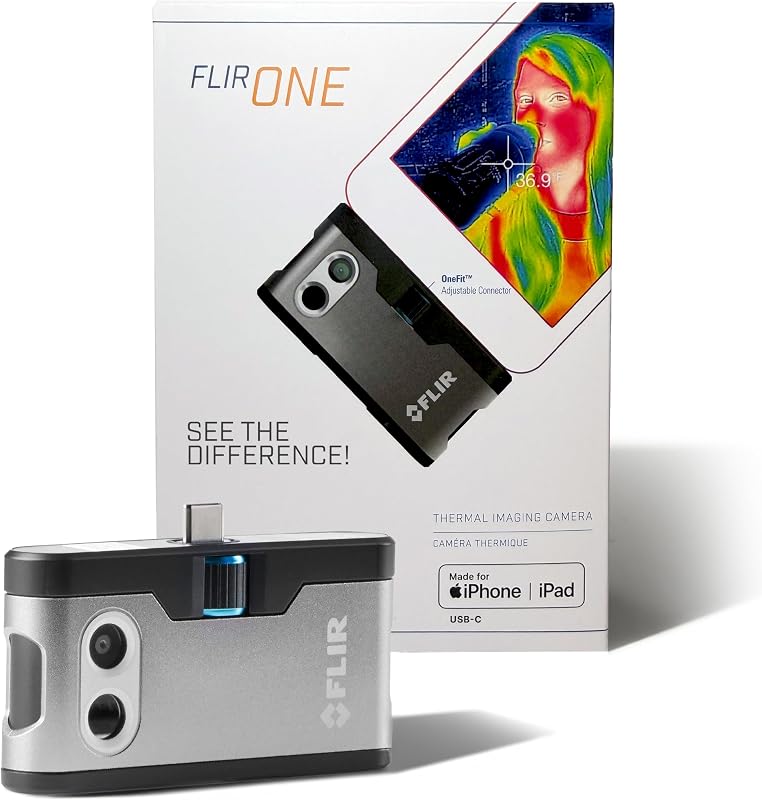
The Flir One offers a streamlined entry point for owners of USB-C equipped Apple handsets who want thermal diagnostics without pro-tier sensor density. Built with an 80×60 native infrared sensor, the device employs VividIR technology to boost imagery up to a 240×180 super-resolution presentation. It shares the physical chassis of the Pro version, measuring 2.6 by 1.3 by 0.6 inches with a total weight of 1.28 ounces. It plugs directly into the bottom of the phone, drawing no power from the phone’s internal supply thanks to its self-contained battery pack.
Despite its simpler native sensor array, it includes the same MSX edge-enhancement technology found on premium models, allowing you to clearly read mechanical labels, see panel breaker numbers, and distinguish structural framing through heat gradients. The software provides built-in troubleshooting guides to walk beginners through routine household inspections, such as tracking down drafty windows or checking heating elements. The hardware carries a drop rating of 1.5 meters, offering reliable resilience against accidental slips on tile or concrete floors.
This entry model yields to the wireless Edge series when you need to inspect awkward angles without bending your neck, or to the Flir One Pro when resolving tiny electrical components requires higher native pixel density.
FLIR ONE Pro LT
- Color black
- Dimensions 2.6 x 1.3 x 0.6 inches
The FLIR ONE Pro LT is engineered specifically for older Apple smartphones that utilize a proprietary Lightning port. The manufacturer listing explicitly warns that this model is not compatible with USB-C devices like the iPhone 15 and later. It integrates an 80×60 thermal sensor paired alongside a 1440×1080 visual camera to deliver clear MSX composite overlays. A distinctive mechanical feature on this unit is the OneFit adjustable connector dial, which raises or lowers the Lightning jack so you can seat the accessory firmly without stripping off your protective phone case.
Weighing 1.28 ounces and enclosed in a matte ABS casing, the device is drop-tested to withstand impacts from 1.5 meters. It connects to the FLIR Ignite cloud ecosystem over your phone’s network connection, enabling automatic file organization, cloud storage, and rapid report sharing right from the field. The listing states that this model is not waterproof and cautions against using it to measure extreme hazards such as open flames or molten metal, but it maintains standard diagnostic accuracy within plus or minus 3 degrees Celsius or 5 percent.
The FLIR ONE Pro LT is the correct choice for anyone holding onto an older Lightning-based iPhone, but it immediately gives way to the modern USB-C Flir One models if you upgrade your phone hardware.
Flir Edge
- Best for Inspectors scanning tight automotive spaces
- Size Edge
- Color black
- Weight 0.33 Pounds
- Dimensions 5.87 x 1.38 x 1.48 Inches

Our score: 9.2/10
Pros
- Wireless Bluetooth connectivity
- Rugged 2-meter drop protection
- Water-resistant construction
- Two-hour average battery life
Cons
- Lower native 80×60 thermal resolution
The Flir Edge departs from the plug-in dongle format by utilizing a completely wireless Bluetooth and Wi-Fi architecture. This untethered design allows it to communicate with virtually any modern iOS or Android device, eliminating charging port compatibility hurdles completely. The camera features an 80×60 native infrared sensor that outputs a 240×180 image via VividIR upscaling, alongside standard MSX edge blending. Much like technicians who monitor production cameras using a dedicated feel world monitor 4k, you can hold the camera probe inside an engine bay with one hand while watching live thermal video on your phone screen in the other.
According to its technical specifications, the Flir Edge provides up to 2 hours of average battery life and captures video clips in MOV or MP4 formats alongside standard JPG still photographs. The housing is water-resistant and holds an elevated 2-meter drop resistance rating, making it the most drop-resilient casing among the entry-level options. It supports direct uploads to the FLIR Ignite cloud service, so your inspection captures are backed up immediately whenever a wireless data network is available.
While the Flir Edge solves physical port conflicts and tight-space inspections, it gives way to the Flir Edge Pro if your work calls for higher infrared resolution.
Flir Edge Pro Wireless Thermal Imaging
- Best for Technicians wanting wireless freedom and sharp detail
- Color black
- Size Edge Pro
- Weight 0.33 pounds
- Dimensions 5.87 x 1.38 x 1.48 inches
Pros
- Higher 160×120 native resolution
- Wireless remote phone view
- VividIR upscaling to 480×360
- FLIR Ignite cloud sharing
Cons
- Listing notes not water resistant
The Flir Edge Pro Wireless Thermal Imaging combines the physical freedom of a wireless form factor with the enhanced clarity of FLIR’s professional-tier sensor. It incorporates a 160×120 native infrared core capable of upscaling to 480×360 pixels through VividIR processing. Connecting via Bluetooth and Wi-Fi, the camera can clip directly to your smart device for single-handed operation or be unclipped entirely to inspect inaccessible ceiling cavities, crawlspaces, and high-voltage cabinets from a safe viewing distance.
The camera listing highlights both automatic and manual exposure controls, giving technicians granular authority over scene dynamics. Images and MP4 videos can be stored locally on the smartphone or synced directly through FLIR Ignite cloud services for team collaboration. Unlike the standard Edge model, the technical specifications for the Edge Pro indicate that it is not rated as water-resistant, meaning it should be kept clear of wet weather and active plumbing leaks during operation. It retains standard thermal measurement accuracy of plus or minus 3 degrees Celsius or 5 percent across normal inspection conditions.
The Edge Pro stands as the most capable cordless unit in the family, stepping aside only when a user specifically prefers the zero-lag, no-charging convenience of a direct USB-C plug-in camera.
Flir One Pro Thermal Imaging Camera
- Color Black
- Size 1 Count (Pack of 1)
The Flir One Pro Thermal Imaging Camera is built specifically for Android mobile devices equipped with a USB-C charging interface. It carries a 160×120 native thermal resolution sensor, bringing professional diagnostic capabilities to phones from manufacturers like Samsung and Google. VividIR upscales the live display to 480×360 pixels, and MSX processing extracts contrast lines from the secondary visual lens to sharpen indistinct temperature patterns. When operating in rough shop environments, having dedicated, durable capture gear is just as essential as outfitting a go pro for motorcycle helmet for all-weather recording.
This imager weighs 1.38 ounces and features drop testing from heights up to 1.5 meters. The integrated rechargeable lithium-ion battery prevents the thermal hardware from depleting your mobile phone’s operating power during long diagnostic sessions. Through the dedicated app, users receive guided assistance for locating hidden water damage, missing fiberglass insulation, and overheating electrical breakers. Temperature accuracy follows the established FLIR commercial standard of plus or minus 3 degrees Celsius or 5 percent.
This version is dedicated to Android ecosystems; shoppers searching for an iphone thermal imaging camera should look to the iOS-configured Flir One Pro or the platform-agnostic wireless Edge options instead.
Chip values are fields copied from the Amazon product listing. Scores are out of 10, based on listed specifications and buyer feedback.
Matching a Model to Your Setup
- Homeowners with an iPhone 15 or newer: Choose the Flir One Pro if you want maximum detail for wall insulation audits, or the standard Flir One if you only need occasional leak detection.
- Users holding older Lightning iPhones: Select the FLIR ONE Pro LT to plug straight into your existing phone port without buying special adapters.
- Automotive mechanics checking cramped engine bays: Pick the Flir Edge to snake the camera around intake manifolds while keeping your phone safely propped on a work cart.
- Commercial building inspectors needing high resolution and flexibility: Choose the Flir Edge Pro Wireless Thermal Imaging for crisp 160×120 native resolution combined with detached remote viewing.
- Android smartphone users: Select the Flir One Pro Thermal Imaging Camera with native USB-C to ensure immediate plug-and-play operating system compatibility.
Before You Buy
Before purchasing any mobile thermal imager, examine your device’s physical port and case thickness. While direct plug-in units like the Flir One series fit snugly against bare phones, thick protective cases can occasionally obstruct connection depth, though the Pro LT listing specifically highlights an adjustable OneFit connector dial to help offset this issue. Furthermore, listings for direct plug-in units do not specify broad cross-platform support across differing operating systems; an Android USB-C camera is not listed as compatible with iOS devices, and older Lightning cameras cannot interface with newer USB-C iPhone models.
You must also plan around battery runtimes and environmental limitations. Mobile thermal attachments operate with their own internal batteries rather than relying on phone power, meaning you have to charge two separate devices before starting a long inspection job. Battery runtimes vary, with the Flir Edge listing an average life of 2 hours, whereas listings for direct plug-in units do not specify precise battery longevity in minutes. Additionally, these devices are not rated for extreme environments; several models explicitly note they are not waterproof and should never be pointed directly at extreme heat sources such as active fires or molten materials.
FAQ
Which flir thermal camera to buy for an iPhone 15 or newer?
For an iPhone 15 or newer, you should buy either the Flir One Pro or the standard Flir One with the USB-C connection. Apple shifted to USB-C ports starting with the iPhone 15 family, rendering older Lightning accessories incompatible. Alternatively, you can use the wireless Flir Edge or Flir Edge Pro, which connect over Bluetooth and Wi-Fi regardless of your phone’s port style.
What is the difference between native IR resolution and super resolution?
Native IR resolution refers to the physical number of thermal detector pixels built into the camera sensor, such as 80×60 or 160×120. Super resolution, which FLIR calls VividIR, is a software processing method that mathematically blends and upscales that sensor data into a denser image grid, such as 240×180 or 480×360, producing smoother edges and clearer thermal visuals on your screen.
How does FLIR MSX technology help beginners understand thermal images?
Thermal images alone can appear blurry or indistinct because heat blooms do not have crisp edges. FLIR MSX technology solves this by using a secondary standard camera lens to capture physical object outlines, text, and structural edges. It then stamps those visual details over the heat map in real time, letting you easily identify specific circuit breakers, pipes, or framing studs.
Can I use the Android USB-C Flir One Pro on an iPhone 15?
The product listings treat the Android USB-C and iOS USB-C versions as distinct models with dedicated platform firmware. While both share the same physical USB-C connector shape, you should purchase the model explicitly specified for iOS to guarantee proper app communication and operating system support.
Do FLIR phone cameras drain my iPhone battery while in use?
No, the FLIR mobile thermal cameras listed here feature their own internal rechargeable batteries. They do not draw operating power directly from your smartphone’s battery during an inspection, though you will need to recharge the camera attachment using its own charging cable between projects.