As Amazon Associates, we earn from qualifying purchases. This means we may receive a small commission at no extra cost to you if you click through and make a purchase.
Upgrading a computer storage system can transform a sluggish machine into a fast, responsive workstation, but deciphering modern hardware terms often overwhelms first-time builders and gift-givers. Solid-state storage represents a massive advancement over traditional spinning mechanical hard drives because it holds your files and operating system on silent, non-volatile flash memory chips rather than magnetic platters. When exploring this category, shoppers generally navigate choices between two distinct physical layouts: compact, gumstick-sized M.2 cards that plug directly into modern motherboards, and conventional 2.5-inch drives that slide into standard drive bays using data cables. Understanding these physical shapes and their corresponding communication channels—such as the legacy SATA pathway versus the high-speed NVMe bus—is essential for matching a new drive to a desktop, a portable notebook, or a dedicated home server.
The storage lineup offered by Intel organizes neatly into two specialized tiers defined by their internal NAND flash architecture and operational priorities. The consumer-oriented tier consists of the 660p and 670p M.2 series, which incorporate high-density Quad-Level Cell (QLC) NAND flash memory to deliver expansive digital capacity on modern PCIe interfaces for daily multitasking, office productivity, and gaming. The enterprise tier, showcased by the D3-S4510 product family, utilizes robust 3D Triple-Level Cell (TLC) NAND memory enclosed in 2.5-inch drive bodies. These enterprise-grade units are engineered for persistent read-intensive server workloads, incorporating specialized hardware power-loss protection, hardware encryption, and sustained data endurance designed for continuous network operations rather than short bursts of consumer speed.
Intel Solid State Drives Lineup at a Glance

4.5 average rating left by Amazon buyers
Best for: IT technicians upgrading multi-drive server backplanes
Pros
- Universal 2.5-inch 7mm profile
- Sturdy 3D TLC flash memory
- Silent solid-state operation
Cons
- Listing omits sequential speed figures
- SATA interface limits transfer speed
| Model | Form Factor | Interface | Sequential Speeds | Primary Application |
|---|---|---|---|---|
| Intel D3-S4510 SSDSC2KB019T8 1.92TB SATA 6Gb | 2.5-inch | SATA 6.0 Gb/s | 560 MB/s Read / 510 MB/s Write | Enterprise Servers and Workstations |
| Intel 660p Series M.2 2280 2TB | M.2 2280 | PCIe NVMe 3.0 x4 | 1800 MB/s Read / 1800 MB/s Write | Everyday Laptops and Desktop Storage |
| Intel Solid State Drive SSDSC2KB019T801 D3-S4510 | 2.5-inch (7mm) | SATA 6.0 Gb/s | The listing does not specify | Server Arrays and SATA Storage Bays |
| Intel 670p Series M.2 2280 2TB | M.2 2280 | PCIe NVMe 3.0 x4 | 3500 MB/s Read / 2700 MB/s Write | Gaming and Fast Data Processing |
Figures as published on the product listings.
The Models in Detail
Intel D3-S4510 SSDSC2KB019T8 1.92TB SATA 6Gb
- Best for Enterprise servers and continuous round-the-clock workloads
- Color Silver
- Weight 0.2 pounds
- Dimensions 2.5 x 2.5 x 1.5 Inches

4.7 average rating left by Amazon buyers
Pros
- Integrated power loss protection
- Durable 1 DWPD endurance rating
- Hardware AES 256-bit encryption
Cons
- Renewed hardware condition
- Legacy SATA throughput ceiling
The Intel D3-S4510 SSDSC2KB019T8 1.92TB SATA 6Gb is an enterprise-class 2.5-inch solid-state drive specifically constructed for read-intensive computing tasks, such as database administration, cloud applications, large-scale analytics, and virtualization. Equipped with 64-layer Intel 3D TLC NAND flash memory, this drive achieves steady sequential read speeds reaching up to 560 MB/s and sequential write speeds of up to 510 MB/s. It delivers 97,000 random read IOPS and 36,000 random write IOPS, ensuring responsive, low-latency access across multi-user environments. Provided through the Amazon Renewed program, this unit functions as a direct drop-in replacement across established enterprise server infrastructure, including platforms from HPE ProLiant, Dell PowerEdge, and Supermicro, without requiring host controller upgrades or structural modifications.
Operational endurance and security define this enterprise model, featuring an endurance rating of 1 Drive Write Per Day (DWPD) and a mean time between failures (MTBF) of 2 million hours for continuous 24/7 deployment. It incorporates robust enterprise data protection technologies, including AES 256-bit encryption, End-to-End Data Protection, and physical Power Loss Protection circuits to safeguard data during unexpected power interruptions. Its specialized firmware is capable of completing software updates without initiating a server restart, minimizing maintenance downtime. While it can physically operate inside a desktop computer equipped with SATA cables, everyday travelers wanting simple external storage might look toward a crucial 2tb external ssd instead, as this internal enterprise drive is tuned for rack servers and mission-critical network enclosures.
Within this brand’s lineup, the D3-S4510 represents the standard for sustained hardware endurance rather than extreme burst speeds. It is limited by the bandwidth boundaries of the SATA 6.0 Gb/s protocol, meaning it cannot match the peak sequential throughput of modern M.2 PCIe NVMe drives. Consequently, it gives way to consumer M.2 drives like the 660p or 670p when a buyer requires ultra-fast boot drives for desktop gaming or compact upgrades for ultra-thin personal laptops.
Intel 660p Series M.2 2280 2TB
- Best for Everyday laptop users seeking secondary mass storage
- Size 2 TB
- Weight 0.02 pounds
- Dimensions 6.5 x 4.75 x 0.75 inches

4.8 average rating left by Amazon buyers
Pros
- Spacious 2TB storage volume
- High-bandwidth PCIe 3.0 interface
- Cable-free M.2 form factor
Cons
- Slower speeds than next-generation models
The Intel 660p Series M.2 2280 2TB is an internal solid-state drive built to bring generous digital storage capacity to personal computers via the modern M.2 2280 form factor. Utilizing Intel QLC 3D NAND flash memory, this drive packs four bits of data into every memory cell, providing 2TB of file space on a single circuit board measuring 22 by 80 millimeters. It operates across the high-speed PCIe NVMe 3.0 x4 interface, delivering rated sequential read speeds of up to 1800 MB/s and sequential write speeds of up to 1800 MB/s. By attaching directly to an M.2 expansion slot on a computer motherboard, it completely removes the need for tangled power cords and ribbon cables inside the chassis.
This drive serves home computer users, office workers, and mainstream gamers who want to expand their system storage for digital libraries, documents, and media collections. The listing highlights its broad compatibility across notebook computers, desktop towers, and specialized server arrays designed for M.2 PCIe hardware. For instance, anyone upgrading a modern system such as a dell laptop with solid state hard drive will find this form factor exceptionally convenient because it takes up minimal internal space and draws moderate power during general use. The product specifications also note its suitability for gaming, business, and personal workflows.
Compared to the enterprise SATA drives in this overview, the 660p delivers more than three times the sequential read velocity, offering faster program launch times and rapid file browsing. However, it yields position to its newer sibling, the 670p, which incorporates upgraded flash memory to achieve nearly twice the sequential transfer throughput across the same PCIe 3.0 bus.
Intel Solid State Drive SSDSC2KB019T801 D3-S4510
- Color Silver
- Dimensions 18.5 x 9.75 x 6.25 inches
The Intel Solid State Drive SSDSC2KB019T801 D3-S4510 is a 2.5-inch internal enterprise storage drive housed in a silver-colored 7mm metal chassis. Cataloged under the Youngsville Refresh series label as a generic single pack, this model provides 1.9TB of storage capacity (listed as 1900 GB in the basic specifications table, with 1.92TB identified in the detailed product description). It utilizes 3D2 TLC NAND flash memory and links into system infrastructure via a standard SATA 6Gb/s interface protocol. Its physical design makes it fully compatible with hot-swap drive sleds, server backplanes, and storage arrays engineered for 2.5-inch 7mm SATA hardware.
Designed primarily for business infrastructure, IT departments, and server storage arrays, this drive provides a direct replacement for legacy mechanical hard drives in environments that require low heat output and zero vibrational noise. The listing notes an ATA-4 interface standard and confirms its primary role in server and array data transfer tasks. While the product listing does not specify exact sequential read or write speed figures in its summary bullet points, its hardware architecture is designed around the dependable performance characteristics of the D3-S4510 family, offering reliable storage for consistent network access.
Against the broader catalog, this specific unit provides a new-packaged alternative to renewed enterprise hardware for system administrators seeking standard 2.5-inch form factors. It does not compete with M.2 NVMe drives in raw sequential throughput due to the inherent constraints of the SATA channel. Instead, it serves users whose motherboards lack M.2 PCIe slots or who require standard 2.5-inch hot-swap functionality across multi-bay server chassis.
Intel 670p Series M.2 2280 2TB
- Best for Demanding PC gamers and active content creators
- Color 2TB
- Size 2TB
- Dimensions 6.4 x 4.8 x 0.8 inches
4.9 average rating left by Amazon buyers
Pros
- Up to 3500 MB/s read speed
- Modern QLC 3D NAND technology
- Generous 2TB digital capacity
Cons
- Requires dedicated PCIe M.2 slot
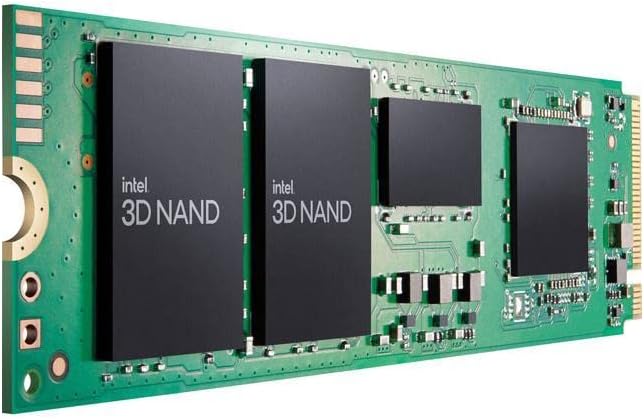
The Intel 670p Series M.2 2280 2TB stands as the high-speed flagship among the consumer models in this guide, engineered to handle heavy multitasking, complex application workloads, and video gaming. Featuring refined QLC 3D NAND flash memory, this drive pairs a 2TB storage capacity (listed as 2000 GB in the technical table) with a fast PCIe NVMe 3.0 x4 controller. It is rated for sequential read speeds reaching up to 3500 MB/s and sequential write speeds up to 2700 MB/s. These transfer rates represent nearly double the read velocity of the prior 660p generation, drastically shortening operating system startup sequences and reducing software load times.
This model suits demanding PC enthusiasts, content creators, and gamers who need fast internal storage to manage large media assets and expansive modern game installations. Although the listing contains typographical discrepancies in its attributes table—listing a 2.5-inch form factor, 7200 rpm rotational speed, and SATA connectivity—the primary listing title, bullet points, and manufacturer description confirm it is a solid-state M.2 2280 PCIe NVMe drive. For users who need additional mobile storage for moving large files between workstations, pairing this internal card with an external tool like a samsung external ssd or a digiera portable ssd provides a comprehensive storage ecosystem.
Within the brand’s portfolio, the 670p represents the fastest consumer drive in this comparison, easily outstripping the 660p in write consistency and peak read speeds. It outpaces the 2.5-inch enterprise drives by several thousand megabytes per second in sequential data transfers, giving way to the D3-S4510 models only when a buyer specifically requires enterprise power loss circuitry, high DWPD write endurance, or physical 2.5-inch SATA bay compatibility.
Chip values are fields copied from the Amazon product listing. Star figures are the average rating left by Amazon buyers, not a score given here.
Matching a Model to Your Setup
- Upgrading a standard business desktop or home media server with standard drive bays: Select the Intel D3-S4510 SSDSC2KB019T8 1.92TB SATA 6Gb for its 560 MB/s sequential read capability, 24/7 duty cycle, and direct drop-in fit for existing SATA cables.
- Building a compact home office computer or secondary storage PC: Choose the Intel 660p Series M.2 2280 2TB to gain 2TB of cable-free internal storage with responsive 1800 MB/s transfer speeds.
- Replacing worn drives across multi-bay enterprise server arrays: Pick the Intel Solid State Drive SSDSC2KB019T801 D3-S4510 for its 2.5-inch 7mm profile, reliable 3D TLC NAND flash, and standard SATA backplane compatibility.
- Constructing a fast gaming rig or performance workstation: Install the Intel 670p Series M.2 2280 2TB to maximize responsiveness with sequential read speeds reaching up to 3500 MB/s across modern M.2 PCIe slots.
- Operating an always-on network database or virtualization host: Rely on the Intel D3-S4510 SSDSC2KB019T8 1.92TB SATA 6Gb to protect data integrity with its hardware-level AES 256-bit encryption and integrated power loss protection.
Before You Buy
Before ordering any of these storage drives, buyers must verify the hardware accessories included in the packaging. None of the listed product packages supply mounting screws, standoffs, or thermal heatsinks for the M.2 2280 drives, meaning you must check whether your desktop motherboard or laptop chassis already possesses the tiny retention screw required to hold an M.2 card in place. Similarly, the 2.5-inch SATA drives do not ship with SATA data cables, power extension splitters, or 3.5-inch bay adapter brackets. If you plan to install a 2.5-inch drive into a standard desktop tower or older computer case, you will need to acquire the appropriate connection cables and bracket trays separately.
In addition, several operational aspects remain unstated in the manufacturer listings. The product listing for the Intel Solid State Drive SSDSC2KB019T801 D3-S4510 does not specify sequential read and write speeds, random IOPS values, or endurance metrics within its summary specifications. The listing for the 670p also displays contradictory text in its specifications table, listing mechanical hard disk attributes like 7200 rpm and SATA connections despite being an M.2 NVMe solid-state stick. None of the listings include operating system migration software or cloning cables, so first-time upgraders should prepare a software strategy to transfer their data and confirm that their motherboard BIOS supports NVMe drive booting prior to installation.
FAQ
What is the primary difference in an Intel NVMe vs SATA SSD comparison?
The primary difference lies in the communication pathway and physical connection used to transfer data. SATA solid-state drives connect using traditional data cables or slide into 2.5-inch hot-swap drive bays, operating on an interface protocol capped at roughly 600 MB/s. NVMe drives use the PCIe bus, connecting directly to an M.2 motherboard slot to deliver significantly higher sequential transfer speeds, such as the 3500 MB/s observed on the 670p. SATA models are ideal for server backplanes and older systems, while NVMe models suit modern laptops and desktop motherboards.
How do I prepare for an Intel M.2 SSD upgrade in a desktop or laptop?
To prepare for an M.2 storage upgrade, you must verify that your computer motherboard possesses an available M.2 slot that supports the 2280 form factor (22mm wide by 80mm long) and the PCIe NVMe interface. You will also need to locate the tiny M.2 retention screw, which typically comes with the motherboard rather than the drive itself. Finally, if you intend to use the new drive as your primary boot device, you must ensure your computer BIOS supports booting from NVMe storage and prepare a data cloning application or fresh operating system installation media.
Which Intel solid state drive represents the best Intel SSD for everyday personal use?
For general computing, web browsing, office multitasking, and gaming, the Intel 670p Series M.2 2280 2TB represents the strongest choice among these models. It delivers the fastest sequential read speeds of up to 3500 MB/s and write speeds of up to 2700 MB/s, cutting down system boot times and application loading screens. Its compact form factor plugs directly into modern motherboards without requiring any data cables, making physical installation clean and straightforward.
What should beginners understand about QLC NAND versus TLC NAND memory?
NAND flash memory stores digital information in individual microscopic cells. TLC (Triple-Level Cell) memory stores three bits of data per cell, offering high endurance and consistent sustained write speeds, making it the preferred choice for enterprise server drives like the D3-S4510. QLC (Quad-Level Cell) memory stores four bits per cell, allowing manufacturers to offer higher digital storage capacities in compact physical drives like the 660p and 670p, which is ideal for everyday consumer storage needs.
Can an enterprise Intel D3-S4510 drive be installed inside a regular desktop PC?
Yes, an Intel D3-S4510 drive can be installed in a regular desktop computer provided the case has an available 2.5-inch drive mounting location and the motherboard features a standard SATA data port. You will need a standard SATA data cable and an available SATA power connector from the computer power supply. However, because these drives are built with enterprise features like power loss protection and are optimized for 24/7 server workloads, their capabilities are best utilized in network servers, storage arrays, or workstations.