As Amazon Associates, we earn from qualifying purchases. This means we may receive a small commission at no extra cost to you if you click through and make a purchase.
Choosing a kodak slide scanner often comes down to matching your family film collection with the right screen size, adapter kit, and loading mechanism. Many households have boxes filled with 35mm slides, 110 cartridges, 126 instamatic formats, or vintage movie film strips gathered across decades of family gatherings and holidays. Finding a dedicated device that can digitize slides kodak owners have kept in storage means balancing standalone convenience against screen visibility and tray handling, especially if you want to complete an archiving project without connecting to a computer or learning complex photo editing software.
Kodak organizes its digitizer lineup around clear hardware differences, ranging from ultra-portable toy viewers and compact desk units to large-screen tabletop viewers with quick-feed trays. Some models prioritize maximum viewing comfort with large five-inch or seven-inch integrated displays that function like digital picture frames, while other options focus on space-saving footprints or mobile smartphone capture. Whether you are searching for the best kodak slide scanner as a gift for non-technical relatives or conducting a detailed kodak slide scanner comparison to preserve your own slide archive, understanding how each model handles film feeding, native sensor capture, and external storage will help you decide which kodak slide scanner to buy.
Kodak Slide Scanners Lineup at a Glance
| Model | Display Size | Sensor & Resolution | Film Formats Supported | Storage Method |
|---|---|---|---|---|
| KODAK Slide N Scan Film & | 5-inch LCD | 14/22MP CMOS (22MP interpolated) | 135, 110, 126 negatives and 50mm slides | SD or SDHC card up to 32GB (not included) |
| KODAK Slide N Scan Max Film | Integrated screen (size not specified) | 13MP CMOS (22MP interpolation, 3200 resolution) | 135mm, 110mm, 126mm slides and negatives | SD or SDHC card up to 32GB (not included) |
| KODAK SCANZA Film & Slide Scanner | 3.5-inch tiltable TFT LCD | 14/22MP CCD / 14MP camera snapshot | 35mm, 126, 110, Super 8 & 8mm | SD card up to 128GB (not included) |
| KODAK Mobile Film Scanner | Smartphone screen | Phone camera dependent (1200 dpi listed) | 35mm color/B&W negatives and slides | Smartphone internal storage |
| KODAK Mini Digital Film & Slide | 2.4-inch LCD | 14/22MP CMOS (7200 resolution) | 135, 126, 110, Super 8 & monochrome | 128MB internal memory or SD up to 32GB |
| KODAK Slide N Scan Max Digital | 7-inch tiltable LCD | 13MP sensor (3200 resolution) | 135mm, 110mm, 126mm slides and negatives | SD or SDHC card up to 32GB (not included) |
Figures as published on the product listings.
The Models in Detail
KODAK Slide N Scan Film &
- Best for Maximum screen visibility and photo framing
- Weight 1 pounds
- Color Black/Yellow
Pros
- Large 7-inch tiltable screen
- Digital photo frame mode
- Quick-feed tray system
Cons
- Renewed with 90-day warranty
- SD card not included

Our score: 8.6/10
Best for: Direct standalone scanning without computer setup
Pros
- Smooth continuous feed tray
- 13MP CMOS sensor
- Simple one-touch capture
Cons
- SD card not included
- Screen dimensions not specified
Our score: 9.6/10
Best for: Balancing screen size and continuous tray feeding
Pros
- 5-inch LCD display
- Quick-feeding film trays
- HDMI and USB connectivity
Cons
- SD card not included
- Max 32GB card support
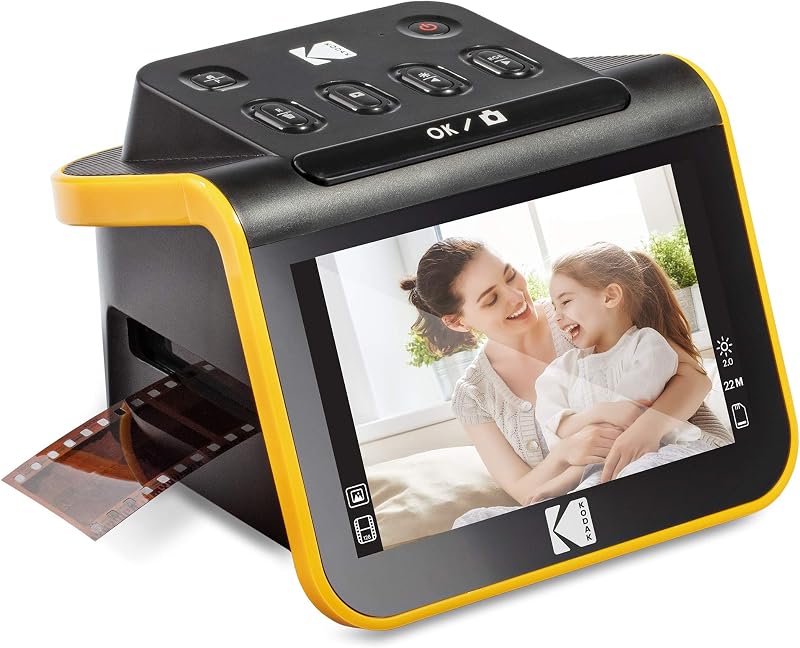
The KODAK Slide N Scan Film & is built around a prominent five-inch LCD display that gives users an immediate, clear view of old negatives and slides before committing them to digital memory. The scanner utilizes a CMOS optical sensor capable of converting film at 14 megapixels natively or interpolating images up to 22 megapixels. Its quick-feeding tray technology allows film strips and mounted 50mm slides to pass through continuously, eliminating the need to pop open an adapter door between every single shot. While modern photographers often store files straight from kodak compact digital cameras, converting physical negatives requires dedicated backlighting and film carriers, both of which this standalone unit provides out of the box.
In terms of versatility, the device accommodates standard 135, 110, and 126 film negatives alongside classic 50mm mounted slides. Color depth is rated at 24 bits, and power consumption is specified at 15 watts. Onboard capture software provides one-touch buttons on the top panel to adjust color balance, tweak brightness, assign date and time stamps, and execute scans. The listing specifies that scanned files save directly onto an SD or SDHC memory card up to 32GB, which is not included in the package. The box does include a 50mm slide holder, custom adapters for 135, 110, and 126 formats, a film cleaning brush, and both USB and HDMI cables for connecting to Windows 7 or newer computers or displaying directly on an external monitor.
This model is an ideal match for family archivists who want a substantial preview screen without attaching the machine to a computer during the scanning session. Its gallery mode allows the unit to double as a tabletop digital photo frame once scanning is complete. However, if your archive contains motion picture formats like Super 8 or standard 8mm film strips, this unit gives way to specialized models that include dedicated motion picture brackets.
KODAK Slide N Scan Max Film
- Weight 1 Pounds
- Color Black/Yellow
The KODAK Slide N Scan Max Film delivers an efficient film digitization workflow in a black and yellow tabletop housing. It utilizes a 13-megapixel CMOS sensor that interpolates files up to 22 megapixels, reaching an output resolution of 4208 by 3120 pixels. Designed to streamline repetitive digitizing work, the machine features a smooth-moving continuous tray mechanism that feeds film strips steadily past the sensor without requiring constant realignment. Lighting is handled by an integrated LED source, and the unit operates with a 50-watt power rating and 24-bit color depth.
Format handling on this kodak film scanner covers 135mm, 110mm, and 126mm film formats, supporting both mounted slides and strips of color or black-and-white negatives. The listing emphasizes standalone operation: you save images directly to an SD or SDHC card of up to 32GB, bypassing computer workstations and scanning software entirely. Single-touch editing controls on the unit allow users to resize, convert, and adjust image properties through simplified hardware controls. The listing notes a standard sheet capacity of 100, measuring 6.69 inches deep, 5.35 inches wide, and 4.45 inches high with a total weight of 16 ounces.
This model suits users who have vast stacks of standard vintage negatives and want a fast, automated feel to pushing film through the scanning gate. The physical tray guidance minimizes finger marks on fragile emulsion layers. If you specifically require detailed knowledge of the built-in screen dimensions before purchase, note that this listing does not specify the exact screen size, meaning shoppers who prioritize a confirmed five-inch or seven-inch screen may prefer other entries in the kodak slide n scan family.
KODAK SCANZA Film & Slide Scanner
- Best for Archiving 8mm film and small negatives
- Weight 1 pounds

Our score: 8.8/10
Pros
- Super 8 and 8mm support
- Tiltable 3.5-inch color display
- Supports up to 128GB SD
Cons
- SD card not included
- Snapshot capture not flatbed
The KODAK SCANZA Film & Slide Scanner stands out for its broad format compatibility, expanding beyond standard snapshot formats to handle 35mm, 126, 110, Super 8, and standard 8mm negatives and slides. Rather than utilizing a traditional flatbed optical drive, the unit houses a built-in 14-megapixel camera that takes high-speed snapshots of back-illuminated film, converting frames to digital JPEG files in seconds. The unit features an optical CCD sensor, a 7200 resolution rating, a 250-watt rating, and measures 4.7 inches by 4.7 inches by 5 inches with an upright, cube-like profile weighing 16 ounces.
Monitoring your work is straightforward thanks to a 3.5-inch TFT liquid crystal display that can be tilted upward, making it easy to review images whether you are seated or standing over the desk. The user interface includes a directory that shows which tray and insert to use for each format. Large one-touch buttons let you adjust red, green, and blue color channels, modify exposure resolution, and browse saved galleries. Storage flexibility is higher than average on the kodak scanza, with support for SD cards up to 128GB, though the card itself is not included. The scanner ships with a USB power cable, HDMI cable, video cable, AC adapter, and a film cleaning brush to clear dust off the light box.
This 35mm slide scanner kodak unit is the right choice for hobbyists who inherited vintage 8mm or Super 8 home movie strips alongside regular photo slides. The inclusion of video output and HDMI cables also simplifies connecting the device directly to a television. Those who only possess standard 35mm slides and want a larger preview screen might find the 3.5-inch monitor modest compared to the wider displays found on the larger Slide N Scan units.
KODAK Mobile Film Scanner
- Best for Casual experimentation using smartphone cameras

Our score: 8.6/10
Pros
- Collapsible lightweight cardboard build
- Battery-powered LED backlight
- Free companion editing app
Cons
- Toy-grade capture quality
- Requires smartphone with camera
The KODAK Mobile Film Scanner offers a unique, analog approach to digitizing memories by pairing a folding cardboard light box with your existing smartphone camera. The system consists of a collapsible cardboard platform, an internal film tray, and a battery-powered LED backlight that provides illumination beneath the film frame. Unlike taking spontaneous outdoor shots with a kodak rugged digital camera, slide digitizing is a calm, indoor archival task that requires even illumination, which this compact cardboard box delivers using simple battery power.
To use this device, you fold out the cardboard tower, switch on the LED base, place your 35mm color negatives, 35mm black-and-white negatives, or 35mm color slides into the dedicated tray, and set your phone flat on the top platform. A custom hole positions your phone lens directly over the illuminated film. Kodak provides a free Android application to manage focusing, basic exposure corrections, black-and-white inversion, cropping, and instant social sharing. The device measures 5.8 by 4.25 by 4.2 inches when deployed and weighs only 249 grams, collapsing flat into a compact cardboard envelope for storage or travel.
This product is designed primarily for casual play, light experimentation, and nostalgic family afternoons rather than archival preservation. The listing explicitly states that this is an entry-level item where scan resolution depends entirely on the camera optics of your smartphone, with an approximate 1200 dpi reference. It makes a charming, low-maintenance gift for children, grandparents, or students who want to peek at old slides without investing in dedicated motorized or sensor-driven desktop hardware.
KODAK Mini Digital Film & Slide
- Best for Desk archiving with minimal storage footprint
- Color Black
- Weight 1 pounds
Pros
- Compact 2.4-inch desktop footprint
- Internal 128MB memory storage
- International power adapters included
Cons
- Small preview display
- SD card not included
The KODAK Mini Digital Film & Slide offers an all-in-one desktop conversion setup condensed into an ultra-compact footprint measuring 3.41 inches deep, 4.04 inches wide, and 4.04 inches high. Inside this miniature enclosure is a CMOS sensor delivering 14-megapixel native capture with software interpolation up to 22 megapixels and a 7200 resolution rating. The unit processes 135, 126, 110, Super 8, and monochrome negative strips and mounted slides, saving files as standard JPEG images without requiring a host computer.
A built-in 2.4-inch color LCD screen provides real-time framing, with dedicated Home and Scan buttons on the top face for fast menu navigation. Users can alter brightness levels, adjust color parameters, or flip and mirror inverted frames directly from the onboard controls. An unusual advantage of this kodak mini digital film scanner is its internal memory, which holds up to 128MB of images before an external card is strictly necessary. For larger archiving jobs, the side slot accepts standard SD cards up to 32GB, which are sold separately. The box includes a 3-in-1 international power adapter compatible with US, EU, and UK wall outlets, alongside a cleaning wand, USB cable, and TV connection cable.
This compact scanner suits apartment dwellers, mobile archivists, or gift recipients who have limited desk space and want something they can tuck into a drawer when finished. If your family archives also feature prints from vintage single-use cameras, our guide to kodak cameras disposable formats provides helpful background on managing those older film types. For users who struggle to see small text or fine photographic details, the compact 2.4-inch display may feel cramped compared to Kodak’s five-inch and seven-inch viewing screens.
KODAK Slide N Scan Max Digital
- Color Black
- Weight 1 pounds
- Dimensions 5.27 x 5.35 x 3.74 inches
The KODAK Slide N Scan Max Digital represents the largest viewing experience in the brand’s scanner catalog, highlighted by a 7-inch tiltable LCD screen. This model is offered through the Amazon Renewed program and includes a 90-day limited warranty backed by manufacturer inspection. It utilizes a 13-megapixel image sensor to digitize color and black-and-white negative strips as well as mounted photographic slides, producing clear files with a 3200 resolution rating while drawing 50 watts over its USB power connection.
Handling film on this device is straightforward thanks to Kodak’s quick-feeding tray system, which allows continuous loading of film frames without having to open and re-latch a plastic carriage every time. Universal adapter brackets included in the package support 135mm, 110mm, and 126mm film formats. Like its siblings, the device requires no computer connection during operation; images are captured and saved directly to an SD or SDHC memory card up to 32GB. The one-touch software layout allows quick resizing, conversion, and color adjustment from physical buttons, while the massive display doubles as an upright digital picture frame with gallery mode.
This 7-inch model is tailored specifically for users who want maximum on-screen visibility when inspecting damaged, faded, or blurry old slides. The tilting display makes scanning comfortable from multiple seating angles, making it a thoughtful gift for older family historians. Shoppers should note that this listing is a renewed product backed by a 90-day warranty, so those seeking an unopened factory-sealed unit or native 8mm film support should direct their attention to other models in the lineup.
Chip values are fields copied from the Amazon product listing. Scores are out of 10, based on listed specifications and buyer feedback.
Matching a Model to Your Setup
- For scanning standard 35mm slides with maximum screen comfort: Choose the KODAK Slide N Scan Max Digital for its large 7-inch tiltable LCD screen that makes evaluating focus and colors effortless.
- For preserving mixed collections containing 8mm home movies: Select the KODAK SCANZA Film & Slide Scanner, which comes equipped with specialized adapters for Super 8 and standard 8mm film formats alongside regular photographic slides.
- For desktop scanning with balanced screen size and continuous feeding: Pick the KODAK Slide N Scan Film & to take advantage of its 5-inch display, quick-feed tray mechanism, and HDMI output.
- For small workspaces or travelers needing international power: Rely on the KODAK Mini Digital Film & Slide, which features a tiny four-inch footprint, 128MB of internal storage, and a 3-in-1 international power adapter.
- For casual curiosity, children, and budget-friendly smartphone scanning: Choose the KODAK Mobile Film Scanner, which uses your phone camera and a cardboard light box for simple, app-assisted digitizing.
- For rapid conversion of standard negatives straight to memory cards: Go with the KODAK Slide N Scan Max Film to use its smooth continuous tray and one-touch standalone capture.
Before You Buy
Before purchasing any scanner in this lineup, check what is included in the packaging against what your project requires. Across nearly all standalone Kodak film digitizers, external memory cards are not included in the box. While the Mini model provides 128MB of temporary internal storage, you will almost certainly need to purchase a separate SD or SDHC card to store thousands of high-resolution digital images. Pay close attention to maximum capacity limits as well: most Slide N Scan models support cards up to 32GB, while the SCANZA can accept cards up to 128GB. Using a memory card that exceeds the specified gigabyte threshold can cause card read errors.
It is equally important to understand the optical technology used in these machines. These products are standalone digital capture units featuring built-in CMOS or CCD snapshot cameras rather than motorized flatbed document scanners. They are designed to quickly capture and convert previously developed film negatives and slides into convenient JPEG files. They cannot develop raw, unprocessed camera film, nor can they scan physical paper photo prints unless specifically noted by listing hardware. Additionally, several technical parameters, such as exact continuous sheet runtimes or specific display dimensions on certain models, are not specified in the manufacturer listings.
FAQ
Do Kodak slide scanners require a computer to work?
Most Kodak standalone slide scanners do not require a computer to scan your photos. Units such as the Slide N Scan, SCANZA, and Mini Digital contain built-in LCD screens, dedicated image processing software, and SD card slots, allowing you to load film, preview the scan, adjust colors, and save files directly to a memory card. You only need a computer if you wish to transfer the saved digital files from the memory card via USB cable, though you can also insert the card directly into an external card reader.
Which film sizes can a 35mm slide scanner Kodak unit process?
Standard Kodak desktop scanners handle 35mm (135), 126, and 110 film negatives and mounted slides using included plastic adapter brackets. If you have vintage movie film, models like the KODAK SCANZA and KODAK Mini Digital also include specialized guides for Super 8 and 8mm film strips. However, larger film formats such as 120 or medium-format films are not supported by the adapters included with these specific models.
Is an SD memory card included in the box?
The listings specify that SD memory cards are not included with these scanners. You will need to supply your own standard SD or SDHC memory card to save your digitized images. Most models support cards up to 32GB, while the KODAK SCANZA can support cards up to 128GB. The KODAK Mini Digital Film & Slide does feature 128MB of built-in internal memory, but an external card remains recommended for extensive scanning projects.
Can these scanners convert old home movie reels?
Certain models in this lineup can convert Super 8 and 8mm film strips frame by frame, specifically the KODAK SCANZA and the KODAK Mini Digital Film & Slide. These units feature dedicated trays that accept motion picture film strips. However, they capture still JPEG images of individual frames rather than playing back moving video reels. The standard Slide N Scan models do not list compatibility with 8mm or Super 8 film.
How does the quick-feeding tray work on a Kodak slide n scan model?
The quick-feeding tray mechanism on Slide N Scan devices allows continuous loading action. Instead of having to open a hinged plastic bracket, insert a single slide, snap it shut, and lock it into the scanner, you can slide mounted slides or film strips into the entry slot and push them through smoothly one after another. This design speeds up the digitization process significantly when working through hundreds of family slides.