
As Amazon Associates, we earn from qualifying purchases. This means we may receive a small commission at no extra cost to you if you click through and make a purchase.
Shopping for outdoor observation gear often leads first-time buyers and gift-givers to a major crossroad between streamlined convenience and modular flexibility. When exploring leupold rangefinder binoculars, shoppers quickly encounter two different philosophies for spotting game and estimating yardage in the field. The first approach relies on an all-in-one optical system where an electronic laser rangefinder is built directly inside a full-sized pair of hunting binoculars. The second approach separates these tasks into two dedicated devices: an ultra-compact handheld laser rangefinder that slips into a chest pocket, paired with a traditional pair of premium optical binoculars designed purely for viewing comfort and resolution. Deciding which setup makes sense requires balancing the physical ergonomics of carrying gear against the speed of calculating distances in dynamic outdoor environments.
Leupold organizes its hunting optics catalog into clear tiers based on mechanical design, internal electronics, and intended use in the wild. The lineup ranges from high-end hybrid devices that house sophisticated ballistic calculators within a binocular body, down to specialized single-purpose tools engineered for lightweight maneuverability. Rather than treating range-measuring devices as a single uniform category, the brand separates products into dedicated observation glass, pocket-sized monocular rangefinders, and integrated binocular systems. Understanding how these models differ in optical chassis materials, digital displays, and environmental weatherproofing allows beginner hunters and thoughtful gift-shoppers to navigate a leupold rangefinder binoculars comparison with complete confidence.
Leupold Rangefinder Binoculars Lineup at a Glance
| Model | Device Format | Ranging Engine and Display | Optical System and Housing |
|---|---|---|---|
| Leupold BX-4 Range HD TBR W | 10x42mm Range-Finding Binocular | True Ballistic Range/Wind with Red OLED | Elite Optical System, Guard-ion Coating, Porro Prism |
| Leupold RX-1400I TBR W Gen 2 | Handheld Monocular Laser Rangefinder | True Ballistic Range/Wind with TOLED and Flightpath | High-transmission optical glass with Polymer Housing |
| Leupold BX-3 Alpine HD Binoculars | 10x42mm Standard Binocular | Non-electronic visual observation only | Elite Optical System with Magnesium Chassis |
Figures as published on the product listings.
The Models in Detail
Leupold BX-4 Range HD TBR W
- Best for Rifle hunters seeking all-in-one glassing speed
- Color Shadow Gray
- Weight 2.44 Pounds

4.1 average rating left by Amazon buyers
Pros
- Integrated TBR/W ballistics engine
- Bright red OLED internal display
- Elite Optical System with Guard-ion
- 100% waterproof and fogproof build
Cons
- Heavier than standalone binoculars
Hunters who refuse to compromise between glassing the landscape and taking immediate distance measurements will find their solution in the Leupold BX-4 Range HD TBR W. Identified by model number 182883, this optic combines a full-sized 10x42mm binocular configuration with an integrated digital ranging engine housed in a Shadow Gray chassis. It utilizes a Porro prism optical configuration alongside Leupold’s Elite Optical System, which is specifically tuned to deliver excellent light transmission, crisp edge-to-edge resolution, and significant glare reduction during difficult dawn and dusk lighting. The objective lenses measure 42 millimeters across, producing an exit pupil diameter of 4.2 millimeters and an expansive field of view of 29.5 degrees. Exterior lens surfaces receive a Guard-ion lens coating to shed rain, mud, and finger oils, while the entire housing is 100 percent waterproof, fogproof, and backed by a lifetime performance guarantee.
The electronic heart of this model is its integrated True Ballistic Range/Wind (TBR/W) processor, which translates complex shooting angles into realistic shot solutions. When viewing game across steep mountain ravines or rolling timber hills, standard line-of-sight distance readings can cause hunters to overshoot or undershoot their targets. The TBR/W calculation accounts for incline and decline angles ballistically, delivering true ranges directly through a bright red OLED display that remains clearly readable against dark timber or thick underbrush. A smooth center focus wheel keeps both optical barrels dialed in for visual scanning, and the chassis includes a tripod mount receptacle for hunters who prefer stabilizing their glass on a window mount or tripod during extended glassing sessions.
This unit represents the best leupold rangefinding binoculars for rifle hunters and western big-game trackers who value split-second reaction times. By eliminating the physical movement required to drop a pair of binoculars and raise a handheld rangefinder, it prevents animal spooking when a trophy emerges. However, this integrated design gives way to standalone tools for users who prioritize minimal neck fatigue or archers operating out of snug tree stands, where an independent pocket rangefinder paired with traditional observation binoculars offers a significantly lighter, more maneuverable physical profile.
Leupold RX-1400I TBR W Gen 2
- Best for Archers needing angle calculations and compact carry
- Color Red
- Dimensions 4 x 1.4 x 3 Inches
4.1 average rating left by Amazon buyers
Pros
- Flightpath arrow clearance indicator
- Ranging distance up to 1,400 yards
- Adjustable TOLED red display
- Lightweight rugged polymer housing
Cons
- Water resistant rather than fully waterproof
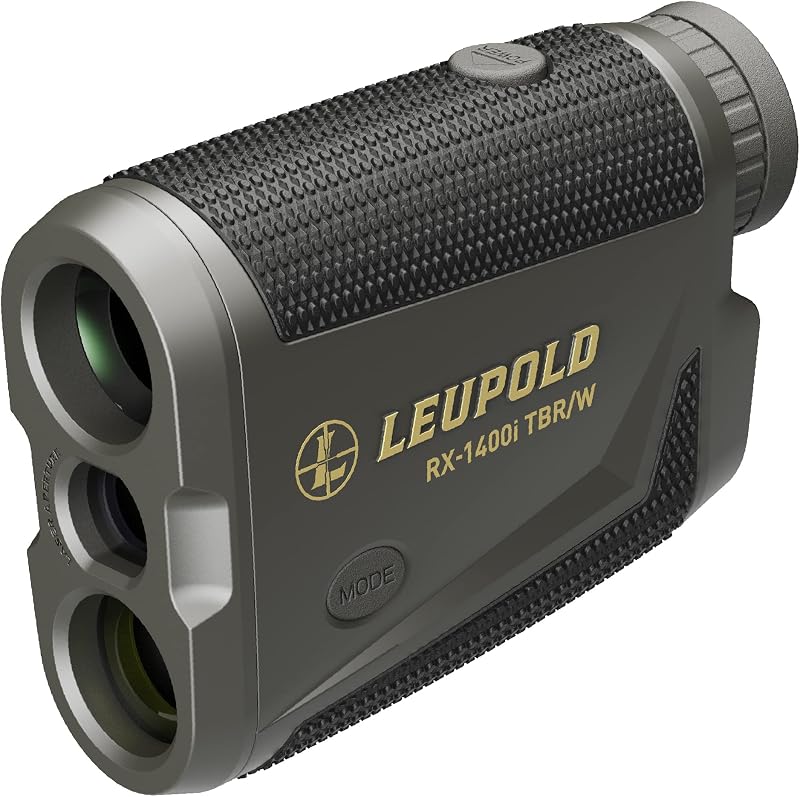
For hunters who prefer a dedicated measuring tool that fits comfortably inside a shirt pocket or bino harness pouch, the Leupold RX-1400I TBR W Gen 2 delivers remarkable functionality. Carrying model number 183727, this compact rangefinder features a durable, lightweight polymer housing finished in black and gray that offers water resistant protection against passing showers. The internal laser ranging engine achieves distance measurements out to 1,400 yards on reflective targets and up to 1,200 yards on natural trees, making it a powerful scouting tool across open fields and dense woodlands alike. Readouts appear on a selectable TOLED display with brilliant red letters and numbers, complete with adjustable brightness settings that hunters can customize to match noon sunlight or fading twilight.
Beyond standard linear measurements, this model includes sophisticated ballistics software specifically tuned for modern archery and rifle platforms. Its True Ballistic Range/Wind software calculates true horizontal distances across steep angles and can even generate an exact hold point for a 10-mile-per-hour crosswind at a 90-degree angle out to 800 yards. For bowhunters, the unit features a dedicated Bow mode powered by Flightpath technology. This system visually indicates the highest point of an arrow’s trajectory arc, allowing archers to identify potential mid-flight obstructions such as low-hanging branches before taking a shot. Gift-givers researching leupold optics for beginners often find this model to be the easiest digital tool to learn, while night-time hunters seeking specialized electronic observation might also examine our overview of visio gear night vision optics to round out their low-light gear collections.
The RX-1400I TBR W Gen 2 suits archers, tree-stand hunters, and budget-conscious outdoorsmen who want advanced ballistic calculation without replacing their favorite existing observation binoculars. It excels in mobile setups where quick single-handed range checks are standard procedure. However, it gives way to the BX-4 Range HD when a hunter needs sustained, two-eyed observation comfort, as a monocular rangefinder causes eye fatigue during long glassing sessions and cannot replace the stereoscopic depth perception of full-sized field binoculars.
Leupold BX-3 Alpine HD Binoculars
- Best for Comfortable all-day scouting without electronic weight
- Weight 0.07 pounds

4.5 average rating left by Amazon buyers
Pros
- Interchangeable Form-Fit eyecups
- Durable lightweight magnesium chassis
- Elite Optical System edge resolution
- Fully waterproof and fogproof construction
Cons
- Lacks integrated laser distance measuring
When continuous glassing comfort and pure optical clarity are the primary objectives, the Leupold BX-3 Alpine HD Binoculars deliver traditional field observation without any electronic complexity. Cataloged under model number 187990, these 10x42mm binoculars feature an attractive Shadow Gray finish and are constructed around a rugged magnesium chassis that provides exceptional structural strength for demanding backcountry terrain while maintaining an ultra-lightweight profile. The optical path utilizes Leupold’s Elite Optical System to maximize light gathering at dawn and dusk, expand the user’s visible field of view, and deliver crisp edge clarity across the entire viewing plane. The barrels are fully sealed to be 100 percent waterproof and fogproof, backed by Leupold’s customer care guarantee for dependable all-weather dependability.
Ergonomics play a central role in the design of this 10-power binocular, making it particularly inviting for users who spend hours searching timber lines for hidden wildlife. It features interchangeable Form-Fit eyecups designed to rest gently against the facial contours, effectively blocking stray side-glare and minimizing eye fatigue over long glassing periods. With a 42-millimeter objective lens gathering ambient light and a 4.2-millimeter exit pupil, the optic produces a bright, steady visual image suitable for tracking game in dense timber or scanning broad hillsides. While casual hikers seeking compact pocket glass might explore recreational tools such as nocs provisions binoculars for simple daytime trail viewing, the BX-3 Alpine HD provides the rugged optical glass and mechanical resilience demanded by serious field hunters.
This model is an exceptional match for general wildlife enthusiasts, first-time hunting buyers, and birdwatchers who want superior optical performance without navigating digital menus, battery compartments, or illuminated displays. It also serves as the ideal primary optical half of a two-piece system when paired with a handheld pocket rangefinder. It gives way to the BX-4 Range HD when a shooter requires an all-in-one chassis that combines long-range target scanning with immediate laser distance measurements in a single motion.
Chip values are fields copied from the Amazon product listing. Star figures are the average rating left by Amazon buyers, not a score given here.
Matching a Model to Your Setup
- Open Country Spot-and-Stalk Hunting: Choose the Leupold BX-4 Range HD TBR W when hunting open plains, western coulees, or high-altitude ridges where bedding game demands continuous glassing and rapid distance calculations without swapping handheld units.
- Dense Timber Archery and Tree-Stand Bowhunting: Select the Leupold RX-1400I TBR W Gen 2 for tight tree-stand perches where its compact pocket footprint, one-handed operation, and Flightpath arrow obstruction indicator provide essential clearance checks.
- Dedicated Wildlife Watching and Birding: Pick the Leupold BX-3 Alpine HD Binoculars when your outdoor goals center entirely on visual observation, natural color fidelity, and comfortable all-day glassing without the weight or expense of electronic ranging sensors.
- Extreme Angle Mountain Rifle Shooting: Go with the Leupold BX-4 Range HD TBR W to take full advantage of its built-in True Ballistic Range/Wind system and bright red OLED display on steep uphill and downhill shots across canyon gaps.
- Flexible Multi-Season Field Kit: Pair the Leupold BX-3 Alpine HD Binoculars around your neck for general scouting with the Leupold RX-1400I TBR W Gen 2 in your pocket for modular versatility across both bow and rifle seasons.
Before You Buy
Before making a final purchase, buyers should review the specific items and operational details that the manufacturer listings do not specify. For electronic ranging models like the BX-4 Range HD and RX-1400I Gen 2, the listings do not specify battery life in terms of total laser actuations or cold-weather operating hours, nor do they clarify whether spare batteries or dedicated cleaning pens are included in the packaging. Furthermore, while the BX-4 Range HD confirms compatibility with tripod mounts, the listing does not specify whether a quick-detach tripod adapter or a chest harness comes inside the retail box, meaning shoppers may need to purchase these carrying accessories separately.
Shoppers should also pay attention to physical specifications and housing dimensions that are omitted or ambiguously stated in the listing data. The BX-3 Alpine HD listing records an item weight of 1.12 ounces, which clearly represents a catalog clerical error rather than the actual physical mass of a full-sized 10×42 magnesium binocular. Additionally, the listings do not specify minimum close-focus distances for either binocular model, nor do they list the exact internal prism type for the BX-3 Alpine HD. Verifying these unlisted dimensions ensures that your chosen optical equipment integrates smoothly with your existing hunting pack, chest harness, and field accessories.
FAQ
What is the difference between a true ballistic range and standard line-of-sight distance?
Standard line-of-sight distance measures the direct straight-line measurement from the rangefinder lens to the animal. However, when shooting at steep uphill or downhill angles, gravity acts on the projectile only across the horizontal component of that distance. Leupold’s True Ballistic Range/Wind (TBR/W) technology uses internal inclinometers and ballistics algorithms to calculate the equivalent flat-ground distance. This allows the shooter to aim using an accurate ballistic hold point rather than overestimating the drop on steep incline shots.
Why does the BX-4 Range HD use a Porro prism rather than a standard roof prism?
The Leupold BX-4 Range HD incorporates a Porro prism design to accommodate its internal laser rangefinding transmitter, receiver diodes, and red OLED optical display pathway. Porro prisms provide excellent light transmission and enhanced stereoscopic depth perception, making it easier for human eyes to separate camouflaged animals from brushy backgrounds. The offset optical barrels also create generous internal space to house electronic components without sacrificing optical clarity.
How does Flightpath technology help bowhunters avoid missed shots?
Flightpath technology is a proprietary archery feature found in the Leupold RX-1400I TBR W Gen 2. Because hunting arrows travel along a high, curving trajectory arc rather than a flat bullet path, overhead obstacles like tree branches or brush can deflect an arrow mid-flight. By calibrating the device to your bow’s specific arrow speed, the TOLED display projects an illuminated mark representing the highest point of arrow flight, letting you confirm that your shooting lane is completely clear before release.
Can a standard pair of binoculars be upgraded with a rangefinder later?
A standard optical binocular like the Leupold BX-3 Alpine HD cannot be retrofitted with an internal laser rangefinder because it lacks the internal electronic sensors, optical beamsplitters, battery compartments, and microprocessors required for laser ranging. Hunters who own standard binoculars typically expand their setup by purchasing a standalone handheld rangefinder like the RX-1400I TBR W Gen 2, carrying the two devices as a complementary modular field pair.
Are all Leupold rangefinding and observation optics completely waterproof?
The degree of moisture resistance varies across different product classes in the lineup. The BX-4 Range HD rangefinding binoculars and BX-3 Alpine HD binoculars are both rated as 100 percent waterproof and fogproof, featuring O-ring seals and gas purging to withstand heavy rain, wet snow, and extreme temperature swings. In contrast, the RX-1400I TBR W Gen 2 monocular rangefinder is classified as water resistant, meaning its polymer chassis easily handles damp mist and light rainfall but should not be submerged under standing water.


