
As Amazon Associates, we earn from qualifying purchases. This means we may receive a small commission at no extra cost to you if you click through and make a purchase.
As an Amazon Associate we earn from qualifying purchases. Links on this page are affiliate links.
The lucky wireless portable fish finder vs wireless kayak fish depth comparison highlights two LUCKY sonar units designed for mobility. Both devices offer wireless operation with an 853-foot range and castable transducers for shore, kayak, or boat use. They share a maximum depth of 147 feet and a 90-degree beam angle. The primary difference lies in their display technology and specific targeting features. One model emphasizes a large color screen with temperature data, while the other focuses on a simpler horizontal LCD for tracking fish history.
Display Type
3.5" Horizontal LCD
Large color display
Fish Identification
Fish icons with depth numbers
Distinguishes small, medium, and large fish
Additional Sensors
Not listed
Water temperature and bottom contours
Included Accessories
Safety tether
Float board for bait boats
Choose the first if
- You prefer a straightforward horizontal scroll to track fish movement history.
- You want a lightweight unit that includes a safety tether for casting.
Choose the second if
- You need real-time water temperature and bottom contour data.
- You want to distinguish between small, medium, and large fish sizes.
Verdict
Choose the 3.5-inch LCD model if you prioritize a clear history of fish movement and simple operation. Select the color display model if you require additional environmental data like water temperature and size-based fish identification. Both units provide the same core wireless range and depth capabilities for your kayak or shore fishing.
Display, Sonar, and Battery Details
Display and Readouts
Edge: LUCKY Wireless Kayak Fish Finder
Product A features a 3.5-inch horizontal LCD display that scrolls from right to left. This continuous history allows you to track fish movement and locate structure you have already passed. It shows fish icons with exact depth numbers next to them. Product B offers a large color display that provides real-time visuals of water depth, temperature, and bottom contours. It distinguishes between small, medium, and large fish with specific depth icons. While Product A focuses on historical tracking, Product B adds temperature data and size classification. Both screens aim for clarity, but Product B includes more environmental data types in its output.
Sonar Technology
Edge: Tie
Both units use a 90-degree beam angle to scan underwater structures. Product A scans a depth area from 3 feet to 147 feet. It reveals the exact depth of fish and their location relative to structure. Product B uses a 125kHz single-beam sonar transducer for high precision. It also covers depths from 2 feet up to 147 feet. The 125kHz frequency in Product B is noted for locking onto exact fish coordinates. Product A emphasizes wide scanning for schools of fish. Product B highlights precision pinpointing. Both achieve the same maximum depth limit of 147 feet, but they approach detection with slightly different technical focuses.
Battery and Power
Edge: LUCKY Wireless Kayak Fish Finder
Product A is described as rechargeable, with a handheld display and floating sensor that are lightweight. The data does not specify the battery voltage or type for this unit. Product B explicitly features built-in 3.7V rechargeable lithium batteries in both the host and the probe. It also provides an intuitive interface that shows signal strength and battery levels for both units. This real-time monitoring helps you manage power during long trips. Since Product A lacks specific battery details in the provided data, Product B offers more transparency regarding power management and technical specifications for the user.
Portability and Design
Edge: LUCKY Wireless Portable Fish Finder 3.5"
Product A weighs 1.54 pounds. It is described as pocket-sized and lighter than a 1-liter water bottle. You can tie the sensor to your fishing line or a safety tether and cast it like a bobber. Product B also features a compact, castable sonar transducer that fits easily into a pocket or tackle box. It includes a specialized float board for bait boats to ensure stable signal transmission. Both units are designed for high mobility and no-drill installation. Product A provides a specific weight, while Product B emphasizes the inclusion of a float board for enhanced stability during casting.
Fishing Applications
Edge: LUCKY Wireless Portable Fish Finder 3.5"
Product A is suitable for shore fishing, kayak fishing, canoe fishing, boat fishing, pontoon fishing, and ice fishing. It is designed for all-season use, including frozen ice holes. Product B is targeted for sea fishing, kayak fishing, boat fishing, and shore fishing, with a specific mention of Bass as a target species. It comes with a float board for bait boats. Both support kayak and boat fishing. Product A has a broader list of vessel types including canoes and pontoons, and explicitly mentions ice fishing. Product B focuses more on specific target species and bait boat compatibility.
Which LUCKY fish finder suits you?
Anglers needing detailed bottom structure data
Our pick: LUCKY Wireless Portable Fish Finder 3.5"
Product A includes a 3.5-inch horizontal LCD that scrolls right to left. This feature lets you track fish movement and identify structure you have already passed. You get clear fish icons with exact depth numbers. This continuous history helps you locate underwater features more effectively than a static screen.
Users wanting water temperature and bottom contours
Our pick: LUCKY Wireless Kayak Fish Finder
Product B displays water temperature and bottom contours alongside fish data. Its large color screen distinguishes between small, medium, and large fish with specific icons. This real-time intelligence helps you choose the right lure. You also see signal strength and battery levels for both the probe and host unit.
Kayakers seeking stable long-range signal transmission
Our pick: LUCKY Wireless Kayak Fish Finder
Product B comes with a specialized float board for bait boats. This accessory ensures stable signal and high-speed data transmission over its 853-foot range. It is ideal for scouting distant spots from a kayak. The 125kHz single-beam sonar provides precise coordinates for bass and other target species in varied water conditions.
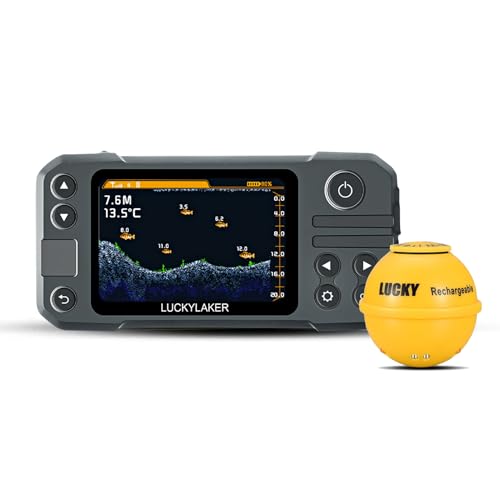
LUCKY Wireless Portable Fish Finder 3.5"
Best for: Kayak and shore fishing with long wireless range
- Display Size
- 3.5"
- Maximum Range
- 147 ft
- Display Type
- LCD
- Fishing Type
- Boat Fishing, Kayak Fishing
- Weight
- 1.54 pounds
This LUCKY wireless fish finder pairs a handheld display with a floating sonar sensor. It offers a 3.5-inch horizontal LCD screen and an 853-foot wireless operation distance. The device scans depths from 3 to 147 feet with a 90-degree beam. Weighing 1.54 pounds, it is designed for kayak, boat, and shore fishing. You can cast the sensor like a bobber for easy setup.
- 853-foot wireless operation distance for long-range control
- 3.5-inch horizontal LCD display for clear depth readings
- Scans fish depth and location within 3 to 147 feet
- 90-degree sonar beam width for wide area coverage
- Heavier build at 1.54 pounds compared to lighter ultralight options
- Maximum scanning depth limited to 147 feet
- Smaller 3.5-inch display size limits screen real estate
- You need a wireless range of up to 853 feet
- You fish from a kayak or small boat
- You want a portable unit that floats
- You require a display larger than 3.5 inches
- You need to scan depths deeper than 147 feet
- You prefer a wired connection for stability
Verdict: LUCKY Portable Wireless Fish Finder suits anglers who value a long 853-foot wireless range and a 3.5-inch LCD screen for kayak or shore fishing. Its 1.54-pound weight and 147-foot depth limit define its practical use case.

LUCKY Wireless Kayak Fish Finder
Best for: Kayak and shore fishing with castable sonar
- Maximum Range
- 147 ft
- Fishing Type
- Boat Fishing, Kayak Fishing
- Target Species
- Bass
This wireless fish finder offers a 147 ft maximum depth range and an 853 ft wireless transmission distance. It uses a 125kHz single-beam sonar with a 90° beam cone to locate fish and bottom contours. The system includes a castable transducer and a handheld host with a large color display. It suits kayak and boat anglers targeting bass who need portable, real-time depth and temperature data.
- 147 ft maximum depth range
- 853 ft wireless range
- 125kHz single-beam sonar
- Large color display
- Castable transducer design
- Single-beam sonar limits scanning width
- 147 ft depth is shallower than many boat units
- You fish from a kayak or small boat
- You need a castable transducer for shore access
- You want real-time depth and temperature readings
- You require multi-beam scanning for wide coverage
- You fish in waters deeper than 147 ft
- You prefer a fixed-mount installation over portable gear
Verdict: LUCKY Wireless Kayak Fish Depth Finder provides essential sonar data for kayak and boat anglers. It fits users who prioritize portability and castable deployment over deep-water or wide-scanning capabilities.
Specifications side by side
| Spec | LUCKY Wireless Portable Fish Finder 3.5" | LUCKY Wireless Kayak Fish Finder |
|---|---|---|
| Display Size | 3.5" | – |
| Maximum Range | 147 ft | 147 ft |
| Display Type | LCD | – |
| Fishing Type | Boat Fishing, Kayak Fishing | Boat Fishing, Kayak Fishing |
| Target Species | – | Bass |
| Boat Type | Kayak | Kayak |
| Weight | 1.54 pounds | – |
Frequently asked questions
Which LUCKY fish finder is lighter for portability?
The LUCKY Wireless Portable Fish Finder weighs 1.54 pounds. This specific weight makes it a manageable choice for anglers who prioritize a lightweight setup. The other model does not list a weight in its published data, so you cannot compare mass directly. You should choose the 1.54-pound unit if minimizing carry weight is a primary concern for your fishing trips.
What is the maximum depth limit for these devices?
Both units share a maximum depth limit of 147 feet. This specification defines the vertical range in which the sonar can detect objects and bottom structure. If you plan to fish in waters deeper than 147 feet, neither device will provide useful data below that threshold. For shallower kayak or shore fishing, this depth range is sufficient for most common scenarios.
Can I use these fish finders from a kayak?
Yes, both models are suitable for kayak fishing. The first unit lists kayak fishing as a primary use case, while the second explicitly targets kayak and boat anglers. Both support wireless operation, allowing you to mount the display unit on your kayak while casting the transducer into the water. This setup provides flexibility for different fishing positions.
Do these devices support shore fishing?
Both the LUCKY Wireless Portable Fish Finder and the LUCKY Wireless Kayak Fish Depth Finder support shore fishing. You can cast the transducer from the bank and monitor the display from a distance. The wireless range allows you to stand comfortably on shore while receiving real-time sonar data. This makes either device a practical choice for bank fishing scenarios.
What is the wireless range of these fish finders?
Both devices offer an 853-foot wireless range. This distance allows you to cast the transducer far from the display unit without losing connection. A long range is useful for covering large areas of water or fishing from a kayak while keeping the screen accessible. This specification ensures reliable communication between the transducer and the display unit.
Which model is better for targeting bass?
The LUCKY Wireless Kayak Fish Depth Finder explicitly lists bass as a target species. This suggests its sonar tuning or display features may be optimized for detecting bass behavior. The other model does not specify target species in its data. If bass fishing is your primary goal, the second model provides a clearer indication of suitability based on its published specifications.


